
Darier Disease: How to Manage Symptoms and Improve Skin Health

Among many diseases, rare ones are found, about which little is known. This includes Darier's disease. In the population, the disease occurs as a single case per 30-100 thousand population evenly in all regions of the world. The disease affects not only the skin, but also the nails, mucous membranes of the mouth and genitals.
The Rare Darier Disease: It's the Genes
Darier-White disease, or follicular dyskeratosis, is a rare disease that is genetically transmitted. It is associated with mutations in certain genes that regulate the transfer of calcium through the membranes of skin cells. Disruption of this process results in poor cohesion between keratinocytes, the main cells of the epidermis.
Dermatosis was first described independently by two scientists in 1889: Darier in France and White in the United States. They also proved the genetic nature of the disease.
The first symptoms appear in 6-20 years, although there are cases beginning at 4 years and at 70 years. Inheritance is autosomal dominant. This means that if one parent has an abnormal gene, the child has a 50% chance of developing the disease. Spontaneous mutations also occur. Symptoms of the disease often coexist with neuropsychiatric disorders.
Symptoms of Darier disease: papules, odor and cobble paving
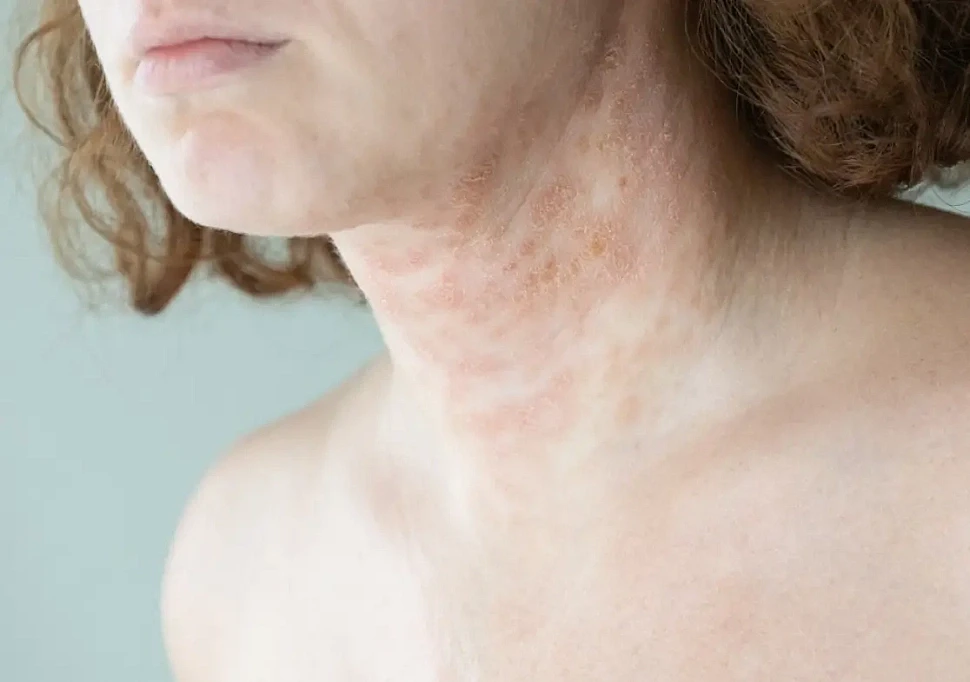
Typical lesions of Darier disease are firm, rough 1- to 3-mm papules; they are yellowish, beige, brown-red, or bodily and grayish. They are coated with keratic grayish crusts, which leave a depression when removed.
Over time, papules may coalesce into plaques of varying shapes. In folds of skin, they may overgrow and form growths with a moist surface. Because of the activity of bacteria, an unpleasant odor appears, which can become foul-smelling. Lesions often cause itching, burning, and tenderness when an infection is attached.
More often, papules are symmetric, but not always. And they usually appear in seborrheic areas, where the function of sebaceous glands is increased, as well as in places prone to friction, high humidity and damaged by solar radiation:
on the head is the forehead, the area around the eyes, the scalp, the "crown" along the line of hair growth, nasolabial and postauricular folds;
on the neck - back and side;
on the torso - in the center of the chest and between the shoulder blades;
The flexor surfaces of the elbows and knees and, less commonly, the dorsal surfaces of the hands and feet are affected
areas of large folds (axillae, inguinal, under mammary glands, intergluteal).
Nails are often affected in follicular dyskeratosis. They show reddish white or white longitudinal stripes, V-shaped notches on the free edge of the nails. The skin under the nails may thicken, and the nails may become concave.
The mucous membranes may also be affected. For example, the mouth—the cheeks, gums, and hard palate—has whitish, raised papules that may cause food discomfort. They coalesce to form a cobblestone sign. Mucous membranes of the genitals may also be affected by similar papules.
The symptoms that occur in the common form of Darier disease are described above. However, there are cases with atypical course and uncharacteristic rashes, which can complicate the diagnosis.
The vesiculobullous form causes additional small and large eruptions, especially where friction, trauma, and heat develop. These eruptions often occur in hot weather, during exertion, and in high humidity.
The hemorrhagic form is a blistering of blood vessels due to vascular disease.
Hypertrophic (vegetative) form. Wet, foul-smelling, wart plaques appear as a primary rash in natural folds.
The acneiform form is a rash of pus, papules, and cysts that very closely resemble common acne. The additional difficulty in diagnosis arises due to the fact that this form often occurs in puberty.
The lichenoid form is similar to the papular lesions of lichen planus. Pruritic plaques are red, flat, polygonal in shape, with a shiny surface.
The pustular form is small, superficial pustules. The disease sometimes occurs in conjunction with erythema—redness of the skin due to dilation of blood vessels.
Localized forms of Darier disease occur with rashes only on certain areas of the body that do not spread further:
Segmental Darier disease - The rashes affect only one part of the body on one side.
palmoplantar form with rashes only on the palms and soles;
isolated nail damage;
isolated mucosal lesions.
In typical cases, it is not difficult to make a correct diagnosis. Doctors focus on the rash features, family history, dermatoscopy, and histologic analysis. Genetic testing can help establish the diagnosis in difficult cases: atypical cases, when the diagnosis is not obvious, or to confirm the diagnosis in doubtful cases. Genetic testing is also needed when planning pregnancy and when there is a high risk of transmitting the disease to the baby
Help for Darier's disease
Like many genetic diseases, Darier disease cannot be cured permanently. Therefore, the main goal of therapy is to prevent exacerbations, control symptoms to improve quality of life.
Local topical therapy plays an important role in treatment. For mild symptoms, keratolytics, topical retinoids, and emollients are the most appropriate and effective treatments. They affect the disturbed process of orogeny, reduce hyperkeratosis, prevent papular formation and soften the skin.
Urea and salicylic acid in high concentrations work well from keratolytics.
For daily use, emotapes in the form of creams and lotions are selected, preferably without fragrances. They are applied after the shower twice a day. It is better to apply ointment to dry areas. They moisturize the skin and reduce itching.
topical corticosteroids and vitamin D drugs are used. Topical calcineurin inhibitors serve as an alternative to corticosteroids when long-term use of topical anti-inflammatory drugs, which do not have significant side effects with long-term use, is required.
Antidepressants and deodorants are recommended to reduce sweating and odor.
When infections join, which is a common complication of Darier disease, topical antibacterial and antifungal agents, as well as antiseptic solutions, are actively used in therapy. In severe cases, these drugs are given systemically by mouth.
If the disease is severe and topical therapy is ineffective, systemic retinoids are taken by mouth. But these drugs are not indicated for the intertriginous and vesiculopustular forms. A tetracycline antibiotic is used if there is a contraindication to retinoids.
Of the physiotherapeutic methods, the most effective are
- light therapy (narrowband UV therapy, PUVA therapy);
- laser therapy (ablative and non-ablative) during remission to align the skin with carbon dioxide and erbium laser;
- dermabrasion;
- cryotherapy;
- electrocoagulation;
- hydrotherapy and balneotherapy - baths with emollients, colloidal oatmeal, starch, broth of lines and chamomiles, which
- relieve itching, irritation, help to soften and remove crusts);
- souls, wiping without aggressive surfactants.
- In any form of the disease and at any stage, maximum protection from the sun as the main factor leading to an exacerbation is necessary. Overheating and rubbing of the skin with clothing should be avoided.
1. Darier Disease with Psoriasis
2. Patients with Darier Disease Exhibit Cognitive Impairment while Patients with Hailey-Hailey Disease Do Not: An Experimental, Matched Case-control Study
3. Genetic Linkage for Darier Disease (Keratosis Follicularis)
4. Localization of the Darier Disease Gene to a 2-cM Portion of 12q23–24.1
5. Bacterial Skin Dysbiosis in Darier Disease
6. Darier Disease – A Multi-organ Condition?
7. Patients with Darier disease have an increased risk of keratinocyte carcinoma: a Swedish registry-based nationwide cohort study