
Inverse Psoriasis: Symptoms and What They Look Like

Psoriasis is one of the chronic inflammatory diseases of the skin. This disease is characterized by the appearance of a typical symptom - there are clearly defined pink areas on the body, on which the skin peels very strongly, covered with large plaques. The affected areas are itchy and cause significant discomfort, significantly disturbing the emotional state of the patient. It would seem that it is not difficult to diagnose the disease at all. But sometimes psoriasis is unusual.
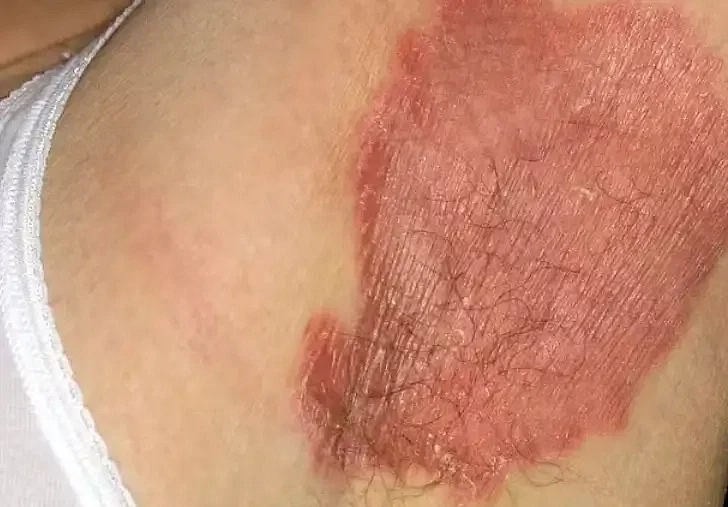
Inverse psoriasis (also called intertriginous or inverse psoriasis) is a clinical form of psoriasis in which lesions appear in large folds of skin. In contrast to classic plaque psoriasis, which most often affects the extensor surfaces (the outer parts of the elbows and knees), inverse psoriasis occurs on the extensor (inner) surfaces.
How it manifests itself
Lesions usually are well-demarcated red (erythematous) plaques with a smooth, shiny surface. The characteristic feature is minimal or no peeling. This is due to the fact that in the folds, the skin is constantly rubbing, and the secret of sebaceous and sweat glands creates a warm, moist environment that prevents the formation of dense scales.
Typical locations:
Groin folds (the most common location)
Axillae;
folds under the breasts;
navel area;
postauricular folds;
perianal area;
elbow and popliteal folds.
Why it looks like this
The appearance is affected by a combination of factors: friction, maceration (softening of the skin from moisture) and constant irritation. As a result, cracks and erosions in the folds are common.
Diagnostic Difficulties
Inverse psoriasis often masquerades as other disorders that also affect the folds: candidiasis, intertrigo (intertrigo), seborrheic, or atopic dermatitis. This similarity makes it difficult for doctors to make an accurate diagnosis right away.
Dermatoscopy, which is examined with a special instrument to look for characteristic features (such as tortuous capillaries), is done to clarify the diagnosis. Skin biopsy may be required in complex cases.
Risk factors and comorbid conditions
Inverse psoriasis is often associated with obesity, cardiovascular disease, and metabolic syndrome. The possible role of bacterial or fungal infection in the development or exacerbation of the process in the folds is also discussed.
How to treat
The approach to therapy takes into account the location: the skin in the folds is thin, prone to atrophy, so the choice of drugs is approached carefully.
Topical corticosteroids remain the first choice but are given for short courses (2 to 4 weeks) because of the risk of adverse effects.
Topical calcineurin inhibitors (eg, tacrolimus ointment) and vitamin D analogs (eg, calcipotriol) are often given for long-term therapy. They are effective and do not cause skin atrophy, which is important for areas with thin skin (folds, genitals).
Topical antibacterial or antiseptic drugs are recommended to be added to the main therapy, as the warm and wet environment of the folds is favorable for secondary infection.
Important nuances
Inverse psoriasis may be isolated (only in the folds) or combined with psoriasis elsewhere in the body.
Such location often causes significant psychologic discomfort and impairs quality of life.
In young children, inverse psoriasis may manifest as "pellucid psoriasis"—intense erythema around the diaper.
If you notice such a rash, be sure to consult a dermatologist. Only a specialist will be able to carry out a differential diagnosis and choose an appropriate treatment taking into account all the characteristics of your case.
1. Biomarkers of Inflammation in Obesity-Psoriatic Patients
2. Association between carbohydrate intake and the risk of psoriasis: a prospective cohort study based on UK Biobank
3.The night matters: sleep quality and evening chronotype associated with clinical severity of psoriasis
4.The causal relationship between gut microbiota and inflammatory dermatoses: a Mendelian randomization study
5. Serum active 1,25(OH)2D, but not inactive 25(OH)D vitamin D levels are associated with cardiometabolic and cardiovascular disease in psoriasis