
Psoriasis - what will help cope with this problem?
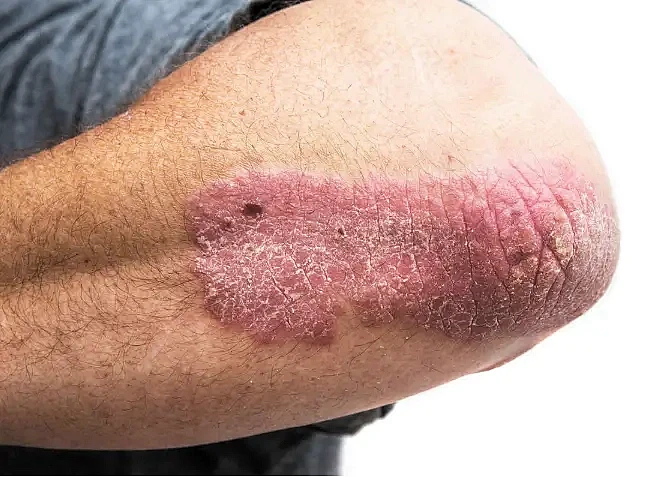
Today, millions of people worldwide suffer from various skin conditions. Psoriasis is one of the most common chronic dermatological disorders, affecting approximately 3.5% of the population. Statistics indicate that women are somewhat more likely than men to face this issue. Treating psoriasis often presents challenges, particularly when it comes to selecting the most effective medication and skincare products. Which product is best suited to help manage psoriasis?
What is psoriasis?
As we said, psoriasis is a chronic skin disease. The main clinical signs of this pathology are papular scaly rashes on the skin, prone to merging into large plaques, often combined with lesions of the nail plates and/or musculoskeletal system.
Today, scientists around the world cannot unequivocally answer the question of why psoriasis develops. It is believed that a hereditary predisposition can lead to its occurrence. For example, some studies have found specific antigens in patients with psoriasis that are suspected of contributing to the disease.
The following are considered as predisposing factors for the occurrence of psoriasis:
- chronic infectious foci in the body;
- severe psycho-emotional overstrain;
- the abuse of alcoholic beverages;
- Taking certain drugs, such as oral contraceptives
- endocrine disorders and more.
- The major morphological element in psoriasis is the papule, or nodule. Papules are pink or reddish in color, with clear
- borders. They tend to merge to form plaques of varying size and shape. The main distinguishing feature of such plaques is
- the presence on their surface of a large number of silver-white scales. If you scratch the hearth slightly, there is an increase
- in scaling.
The most common sites of psoriasis are the scalp, elbows, knees, lower back, and sacrum but can occur almost anywhere on the body.
Some patients indicate itching of variable intensity, but this symptom is not necessary.
The peculiarity of psoriasis is that as it progresses, the characteristic plaques may become larger, and new areas of the body are affected. Naturally, these rashes cause significant psychological discomfort in most cases. In order to cope with it, improve the condition of the skin, make life more comfortable, it is extremely important to choose the right treatment.

Medications for treating psoriasis
There are indeed different groups of drugs with psoriasis - the doctor selects them based on the severity of the disease, the location of the rash and other features.
External (topical) means
They are usually given for mild cases or as part of combination therapy for more severe cases.
Glucocorticoids. Quickly relieve inflammation, swelling, redness and itching. Examples include betamethasone, clobetazole, and mometasone. But it is important: long-term or uncontrolled use can lead to side effects (for example, thinning of the skin), so the doctor chooses the scheme. They are sometimes combined with other components, such as salicylic acid (which softens and helps exfoliate the scales). Examples of such combined means: "Akriderm SK", "Belosalik", "Diprosalik".
Vitamin D analogs (such as calcipotriol). Slow down the excessive division of epidermal cells, affect the immune processes in the skin. Example of a drug: "Divonex".
Keratolytics. Soften and help remove the thickened stratum corneum. Salicylic acid is often used, sometimes in combination with urea.
Preparations with zinc pyrithione. Help reduce inflammation, scaling, and itching. Example: "Skin-cap".
Other means. Sometimes ointments with tar, naphthalan, ichthyol are used - they have anti-inflammatory, disinfectant and emollient effects. Calcineurin inhibitors (such as pimecrolimus) are also available and have immunosuppressive effects.
A few important points
Often, a combination of different techniques—for example, topical therapy plus systemic treatment or phototherapy—is effective.
When choosing a doctor, one considers not only the severity of psoriasis but also the presence of comorbidities (for example, psoriatic arthritis), age, and individual risks.
Even with successful therapy, regular monitoring is important: sometimes the effect can "slip away" (the drug stops working), and the scheme needs to be adjusted.
Some systemic drugs have strict contraindications (eg, severe infection, certain chronic disorders, pregnancy).
Therefore, my main advice is: do not try to pick up the drug yourself. Make an appointment with a dermatologist - he will diagnose, evaluate all factors and make an individual scheme

1. Real‐life effectiveness of once‐daily calcipotriol and betamethasone dipropionate gel vs. ointment formulations in psoriasis vulgaris: final analysis of the 52‐week PRO‐long study
2. Betamethasone valerate dressing is non-inferior to calcipotriol–betamethasone dipropionate ointment in the treatment of patients with mild-to-moderate chronic plaque psoriasis: results of a randomized assessor-blinded multicentre trial
3. Superior efficacy of calcipotriene and betamethasone dipropionate aerosol foam versus ointment in patients with psoriasis vulgaris – A randomized phase II study